


- News
Households, families and business owners are absorbing the tax changes announced in the Autumn Budget, and what they will mean for their future finances. But it can also be reassuring and helpful to reflect on what hasn’t changed.
Claire Trott, Head of Advice at St. James’s Place, says: ‘We already knew there could be no change to income tax or national insurance due to the government’s manifesto pledges. But it will no doubt be helpful for financial planning that there were few other major tax changes for individuals. ‘Consistency can be reassuring for investors and pension savers. Many who are keen for calmer waters will have been relieved at the lack of big announcements or tax changes.’

At a glance
- The £20,000 limit for cash ISA savings will remain the same for all savers.
- Savers and investors will be relieved at the lack of changes to CGT or the pension tax-free lump sum.
- Financial advice can help people navigate Budget changes and avoid acting on rumours and speculation.
Cash ISA limit
Chancellor John Healey has announced that the proposed cut to the cash ISA limit for savers under the age of 65 will be scrapped.
Rachel Reeves, the previous Labour chancellor, had committed to reduce the total amount that could be saved in cash ISAs each tax year from £20,000 to £12,000, for those aged 65 or under. This change was due to come into force from April 2027. But Healey has reversed this plan.
It means all savers can continue to save up to £20,000 in cash ISAs each tax year. This is good news for first-time buyers, many of whom use cash ISAs as a way of saving up a deposit for a property purchase.
It removes uncertainty and the potential complexity around the treatment of cash held inside stocks and shares and investment ISAs. There was due to be a tax charge of 22% on the interest earned on cash held in investment ISAs. This was to prevent savers attempting to circumvent the cash limit rules by holding cash in other types of ISA. Scrapping the reduction to the cash ISA limit for everyone means this tax charge is no longer necessary.
Capital gains tax
Despite fears around potential increases to capital gains tax (CGT) in the run up to the Budget, the chancellor made no changes to this tax for individuals.
There were changes for business owners. The lifetime limit on gains eligible for business assets disposal relief (BADR) was halved from £1 million to £500,000. The new limit will apply from April 2027. The relief allows qualifying business owners to pay CGT at 18% when selling or disposing of their business.
But for individuals, there was no change to the annual exempt amount (AEA) or the rates of tax under CGT.
CGT is owed by individuals if their overall capital gains on the sale of a qualifying asset (after deducting any losses and applying any reliefs) are above the annual exempt amount (there is more on the AEA below).
Basic rate taxpayers pay CGT at 18%. This is if all income and gains for the tax year remain below the basic rate tax threshold for income tax.
Higher and additional rate taxpayers pay CGT on gains at 24%.
It had been rumoured that the chancellor was considering pushing up CGT rates to bring them in line with rates of income tax, which are 20% for basic rate taxpayers, 40% for higher rate taxpayers and 45% for additional rate taxpayers. But this has not happened.
CGT annual exempt amount
The annual exempt amount (AEA) on CGT remains the same following the Budget.
This annual allowance for capital gains on disposal of assets stands at £3,000 per person for the 2026/27 tax year.
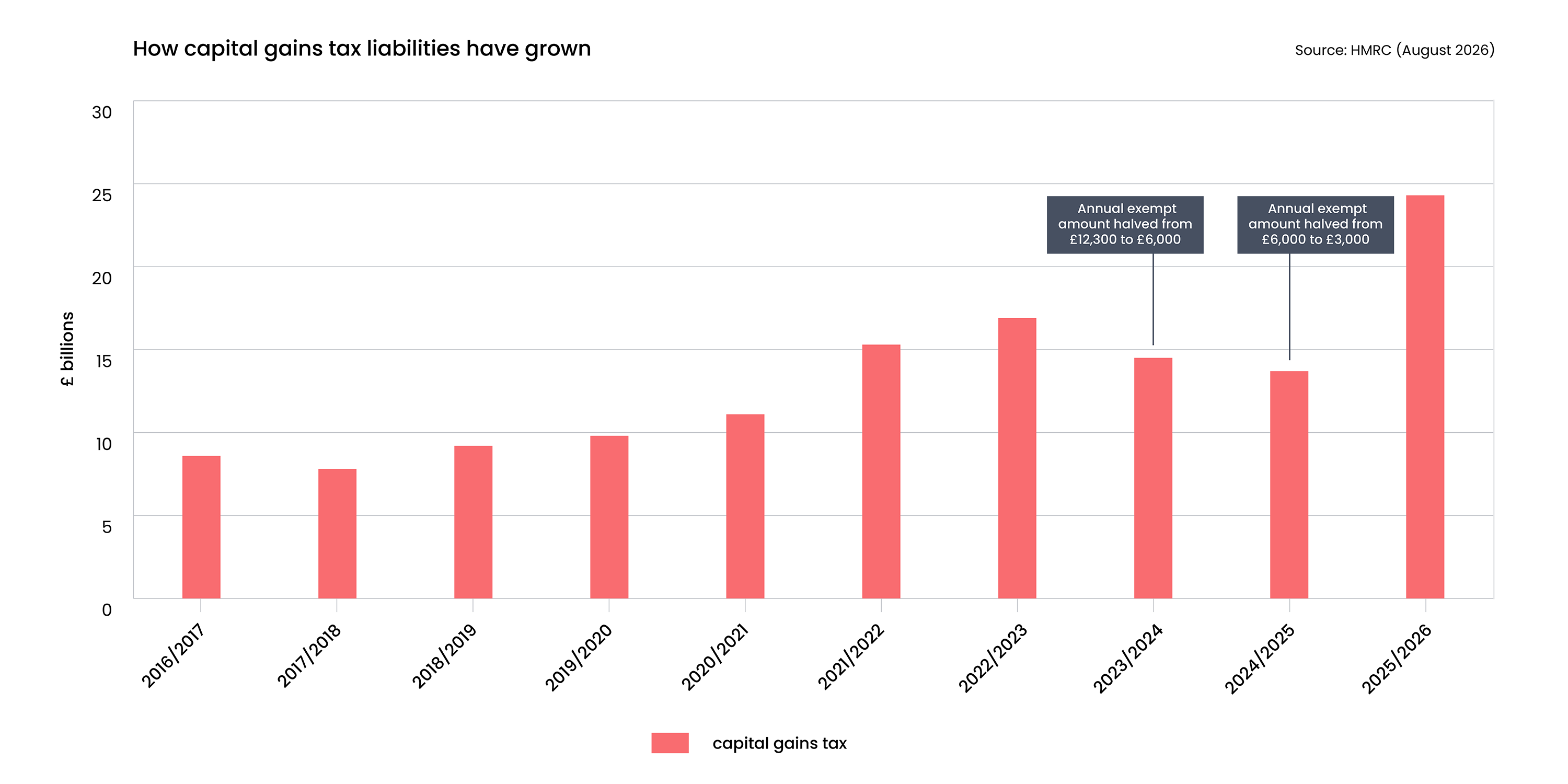
The AEA was cut from £12,300 in the 2022/23 tax year to £6,000 for 2023/24 tax year. It was then halved again to £3,000 from April 2024, where it has remained since.
The data appears to show that the cut to the AEA may have caused some taxpayers to delay the sale of assets. This is because CGT receipts fell between 2023 and 2025. But the CGT take is expected to rise significantly for the current year, as the chart below illustrates.
The Office for Budget Responsibility (OBR) has also forecast that liabilities from CGT (which includes CGT paid by individuals and businesses) will rise to around £26 billion for the 2026/27 tax year, up to £29.2 billion in 2027/28 and up to £32.4 billion in 2028/29.1
The OBR’s long-term forecast predicts CGT receipts will rise to £41 billion in the 2031/32 tax year, which it says will be ‘driven by a forecast of rising equity prices’.2
Pensions tax relief
Higher and additional rate taxpayers were relieved to see the chancellor made no changes to pensions tax relief.
Pension savers receive tax relief on pension contributions at their highest rate of income tax, subject to annual maximum limits.
There had been some speculation that this is one area the government could look to make savings. Reducing pensions tax relief down to 20% for all retirement savers, for example, regardless of their marginal income tax rate, could bring in billions for government coffers. Although it could be viewed as a
disincentive to save.
Tax relief on pensions remains the same.
Pensions tax-free lump sum
As expected, there was no change to the pensions tax-free lump sum. Rumours circulated last year that the government was looking to scrap savers’ access to tax-free pensions cash. It caused a rush of people to access their pension funds early.
There will be widespread relief that the rules around the tax-free lump sum remain untouched by government.
It also highlights the benefit of waiting and not rushing into action around financial planning on the basis of rumours.
No change: summary of tax rates and allowances
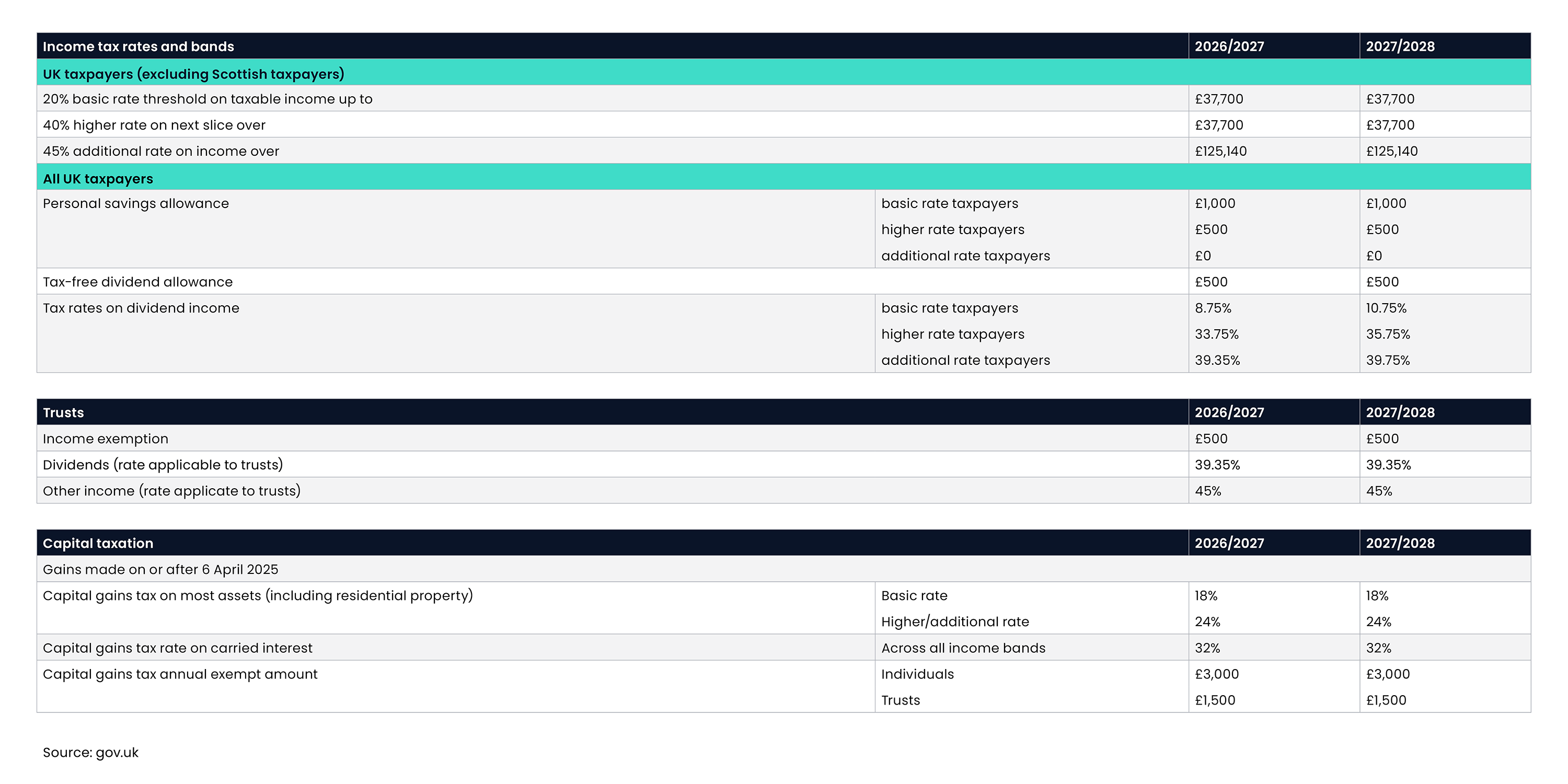
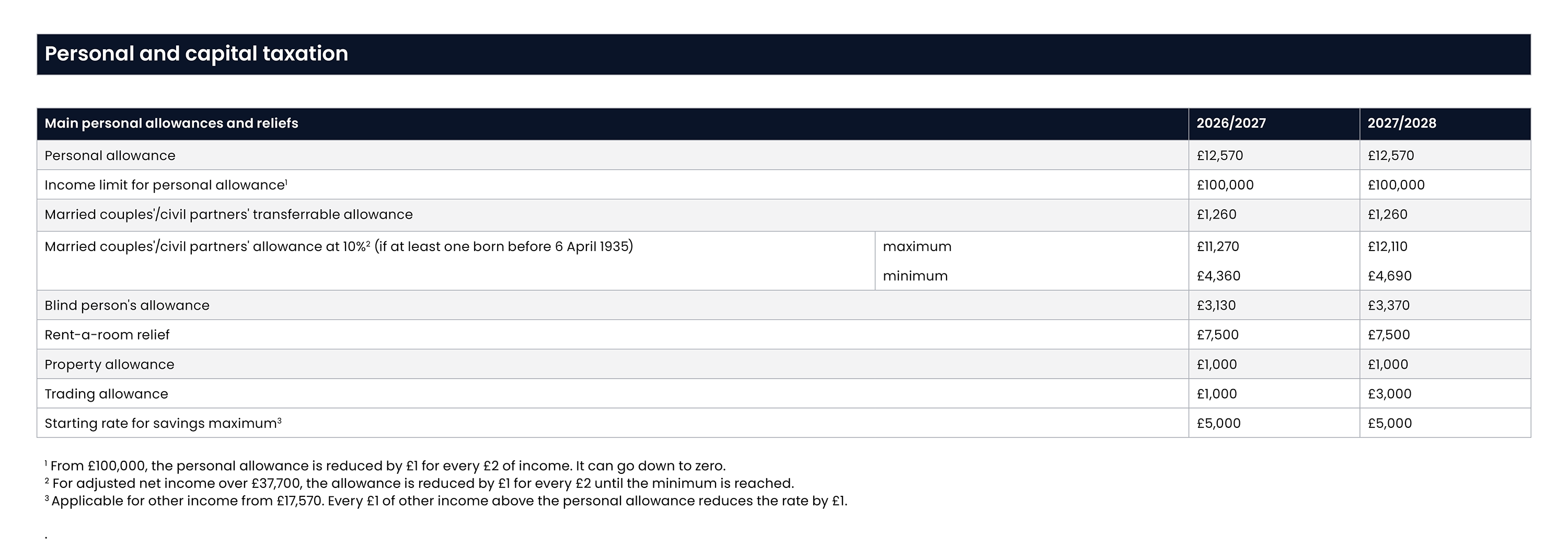
The tables below show a selection of tax rates and personal allowances which have not changed following the Autumn Budget, including income tax, dividend income tax, and CGT.
Sources
1,2 Office for Budget Responsibility. Economic and fiscal outlook – October 2026.

Most popular articles


Most recent articles