


- News
With the support of 90% of Labour MPs (349 in total), Andy Burnham has replaced Sir Keir Starmer as the UK’s prime minister for the remainder of this parliament, ending in August 2029 (at the latest). While pledging to do things differently, there are many challenges ahead. We take a closer look at some of the domestic issues the new prime minister may consider priorities.

1. UK productivity vs. peers
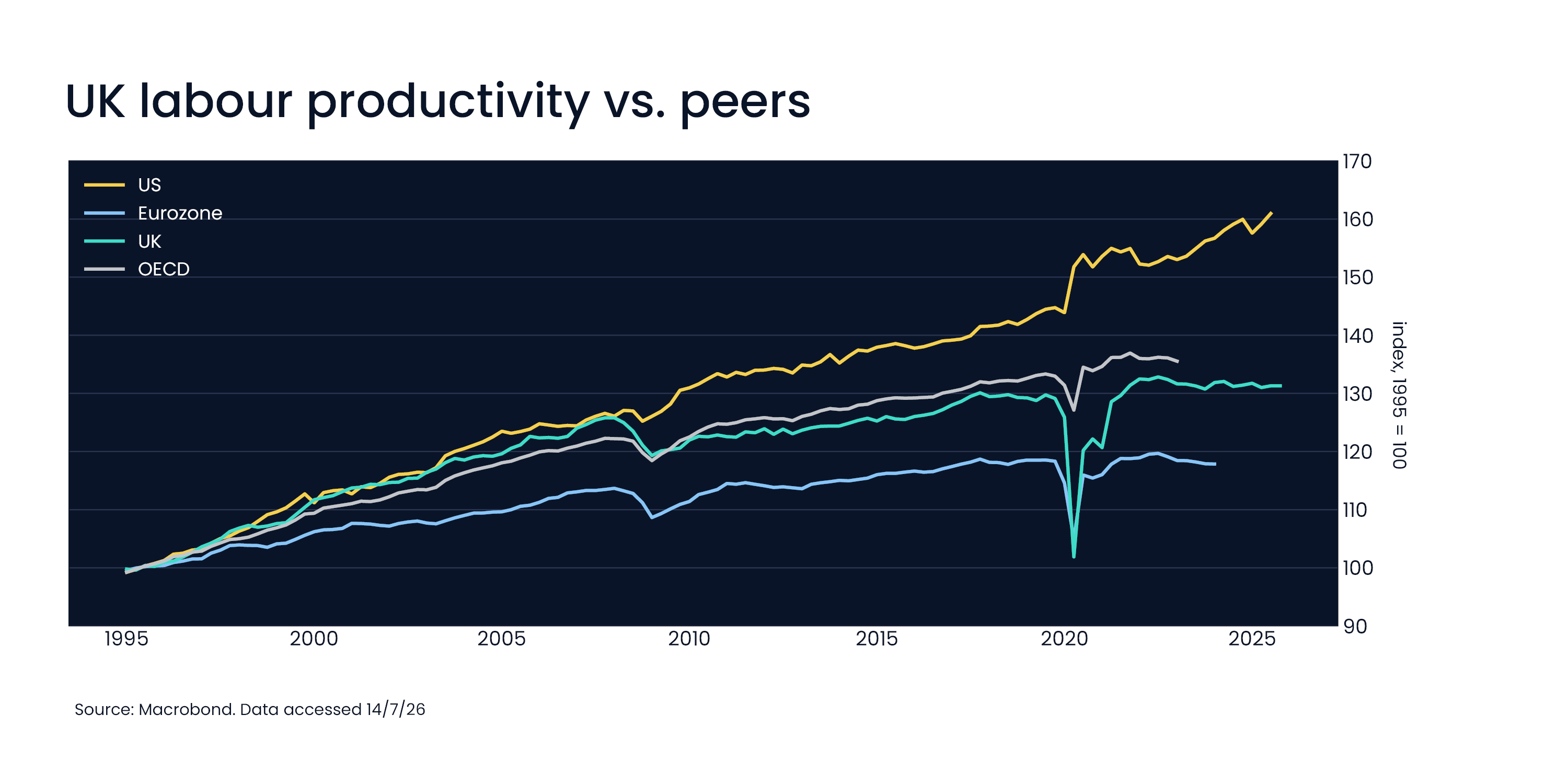
Labour productivity, i.e. how much workers produce per hour, is closely monitored by economists as this is a major contributor to both economic growth and living standards. UK productivity was confidently ahead of the Organisation for Economic Co-operation and Development (OECD) in the decade up to the global financial crisis. Since then, it has struggled.
Differences in productivity between competing economies can be explained by workers’ skills, levels of training and education and the tools used. Even worker health is a consideration, as those with poor health are often not as productive.
Hetal Mehta, Chief Economist at St James’s Place (SJP) comments that: “most of all, the level of investment in the economy is a key driver of productivity. Years of weak business investment have likely contributed to the poor productivity trend relative to many other countries.”
More attractive tax incentives, a less stop-start industrial policy and speedier planning decisions on housing and infrastructure have all been suggested as areas of priority.
2. NEETs in crisis
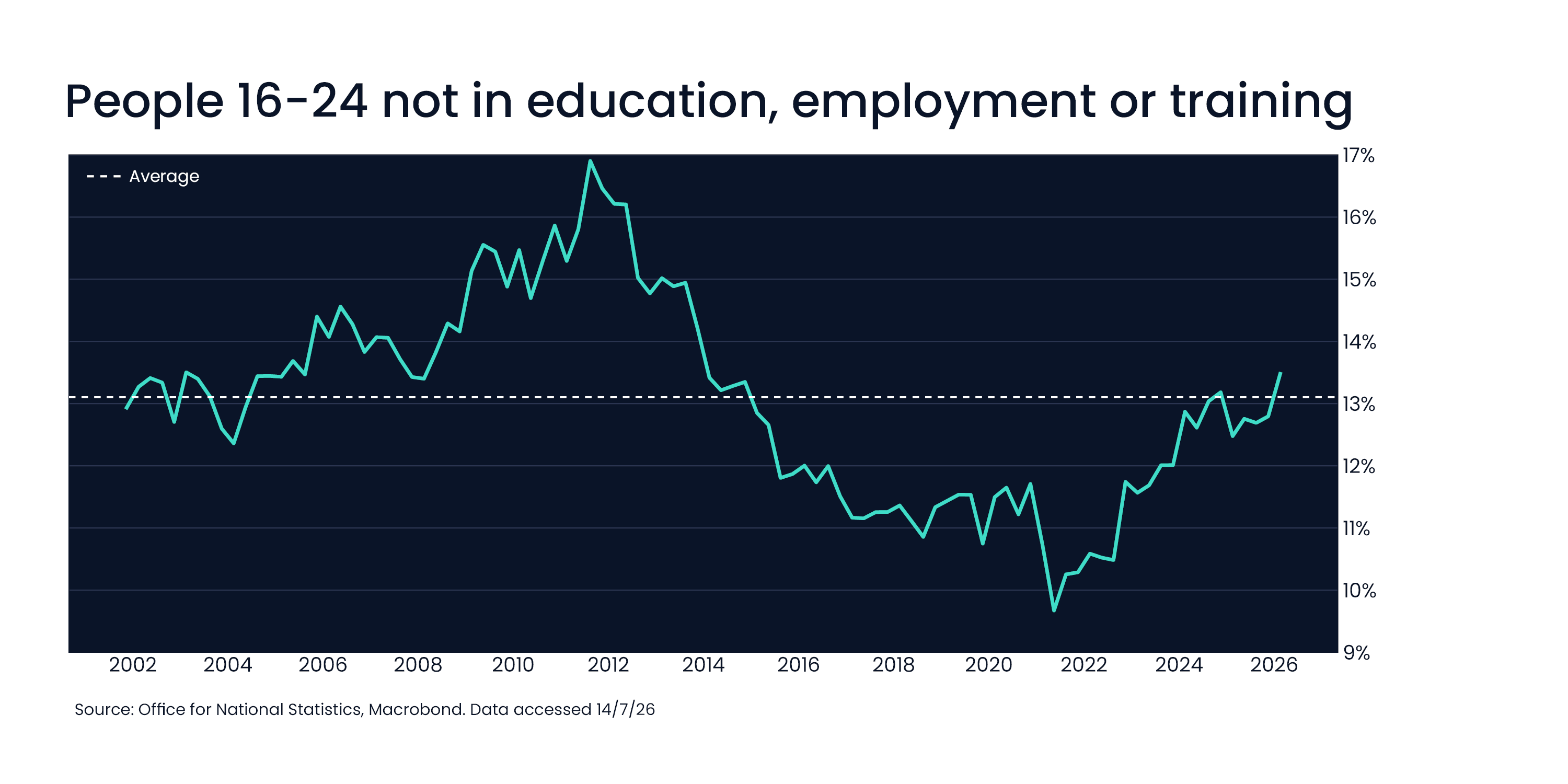
People aged 16 – 24 who are not in education, employment or training are classified as NEETs. UK government data shows that there were one million NEETs in the first quarter of 2026, equivalent to almost 14% of this age group.1 The annual cost of government support is estimated at £125 billion, more than the amount spent on education.2
Within a decade, the UK’s NEET rate has gone from being in line with the European Union average to being pushed to the top of this unprestigious pile, just below Romania.
NEETs are increasingly being referred to as a “lost generation”. As the best predictor of an individual’s future risk of unemployment is their past unemployment history, this categorisation is preparing them for a downward spiral. Unless tackled, the NEET rate could increase to over 16% within five years according to a recently-released government-commissioned report.3
3. What the bond market tells us about UK borrowing costs
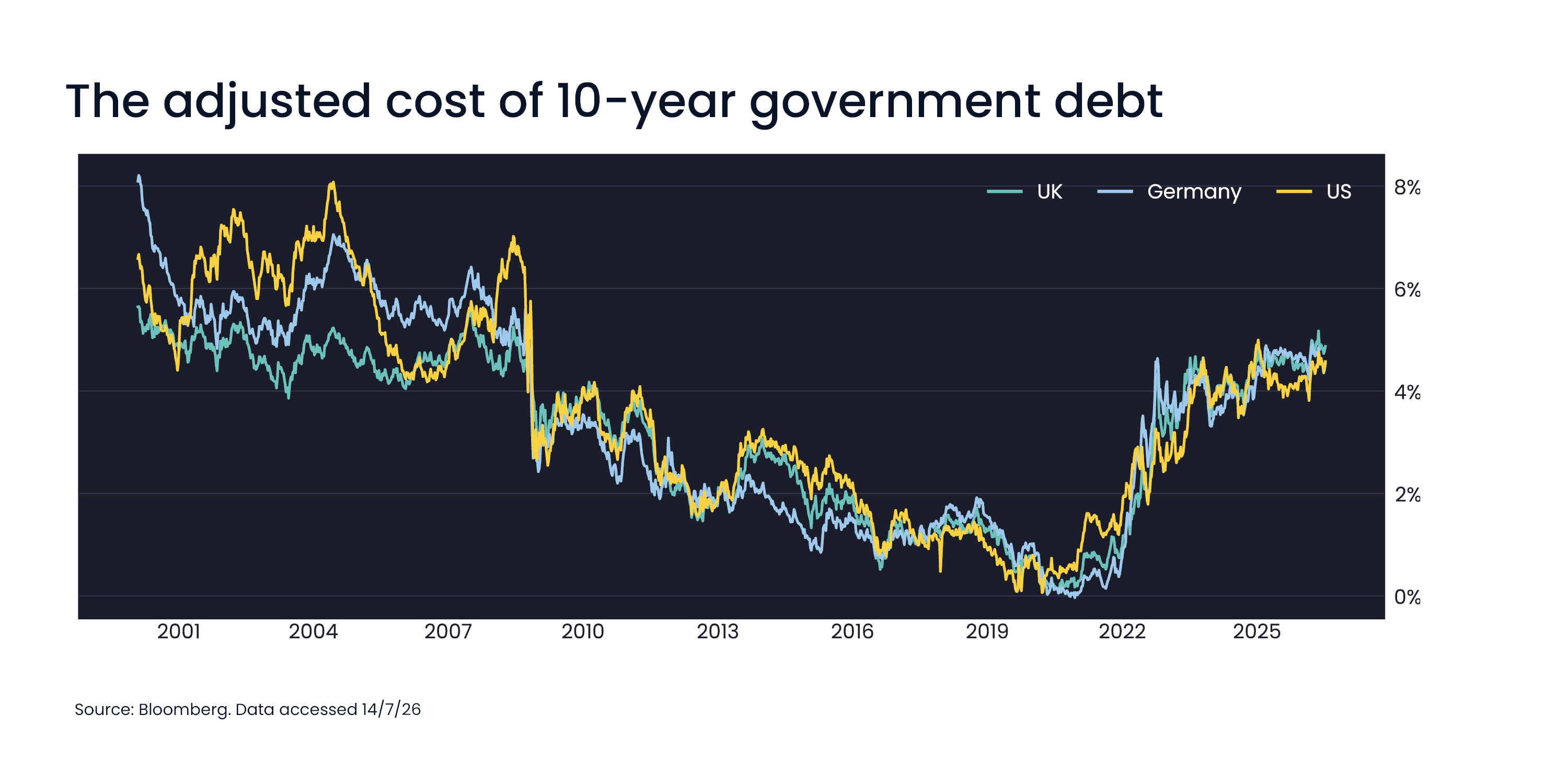
UK bond (gilt) yields are just below 5%, a two-month high and above the equivalent 4.5% for US 10-year Treasuries and the 3.1% for German 10-year Bunds. On paper at least, it seems that the bond market is demanding a premium for buying UK government debt.
To make a fair international comparison, we need to account for the different interest rates and currency risks. Once the different bond yields are “FX-adjusted”, the seemingly higher risk premium associated with UK gilt yields falls away.
UK gilt yields (and sterling) have been underpinned by expectations that the Bank of England (BoE) will raise interest rates this year to prevent higher energy costs from becoming entrenched in higher medium-term inflation.
The transition to a new prime minister brings a further level of uncertainty as few details of Andy Burnham’s agenda have been announced.
On a relative basis, UK gilts offer yields not seen in almost a decade. However, the recent collapse of the ceasefire between Iran and the US, and the subsequent rise in oil prices, is reinforcing fears of higher inflation.
If inflation proves sticky, gilt yields could remain elevated as investors demand a higher yield to compensate for the more uncertain domestic backdrop.
4. Consumer inflation: the energy pinch-point
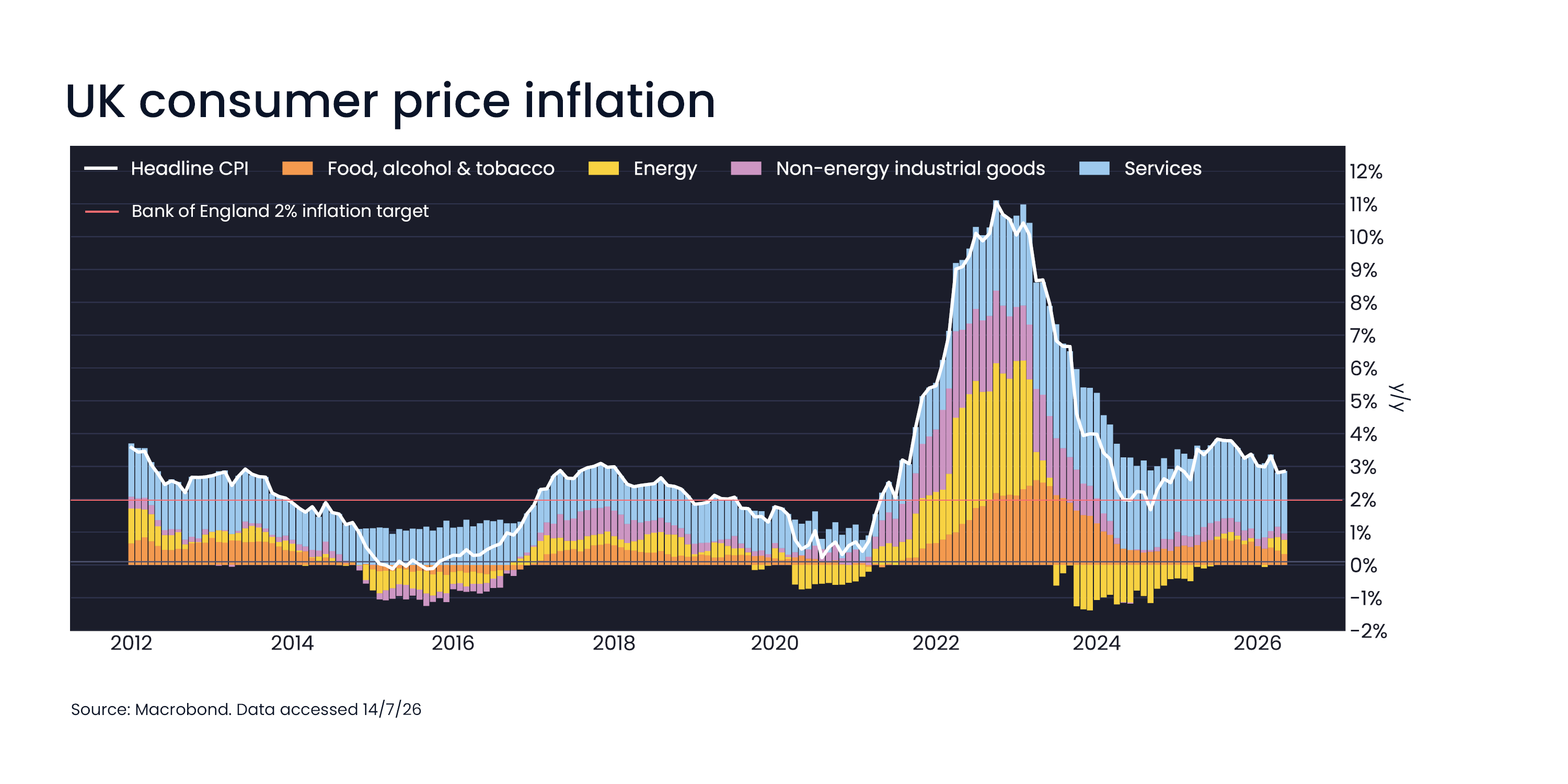
As SJP’s Hetal noted: “inflation has been above the Bank of England’s 2% target for much of the period since the post-pandemic supply chain shock. This year’s US/Iran war has resulted in a further inflation shock, which is increasing the cost of living. If the Strait of Hormuz remains closed to shipping, the Bank will struggle to cut rates, which had been its intention at the start of this year.”
5. Improving the UK’s balance sheet
Good news for the UK economy, with the country’s borrowings finally heading in the right direction. According to the International Monetary Fund (IMF) April 2026 Fiscal Monitor, the UK’s budget deficit will fall from 6.1% of economic output (GDP) last year to 1.6% by 2030. Should this materialise, it will be the sharpest improvement among the major western economies, notable compared with the US and the euro area.
What’s driving this forecast recovery for the UK? The answer is the government’s “non-negotiable” fiscal rules outlined in October 2024. This specified that the government’s day-to-day spending had to be met by revenue (i.e. taxes) by 2030. Less stringent public spending is to be supported by more tax take. In particular, the government’s moves to freeze income tax thresholds (and not revising them upwards to take account of inflation) means that more taxpayers are being pulled into higher tax bands. Targeted taxes on property and employers are also expected to play their part.
Yet, even in the UK, the devil is in the detail. Borrowing is set to rise in the UK over the next few years. The reduction in the deficit will be back-end loaded. In other words, investors will only know much nearer the time whether the stated aims will be achieved.
6. UK tax take set to reach its record high
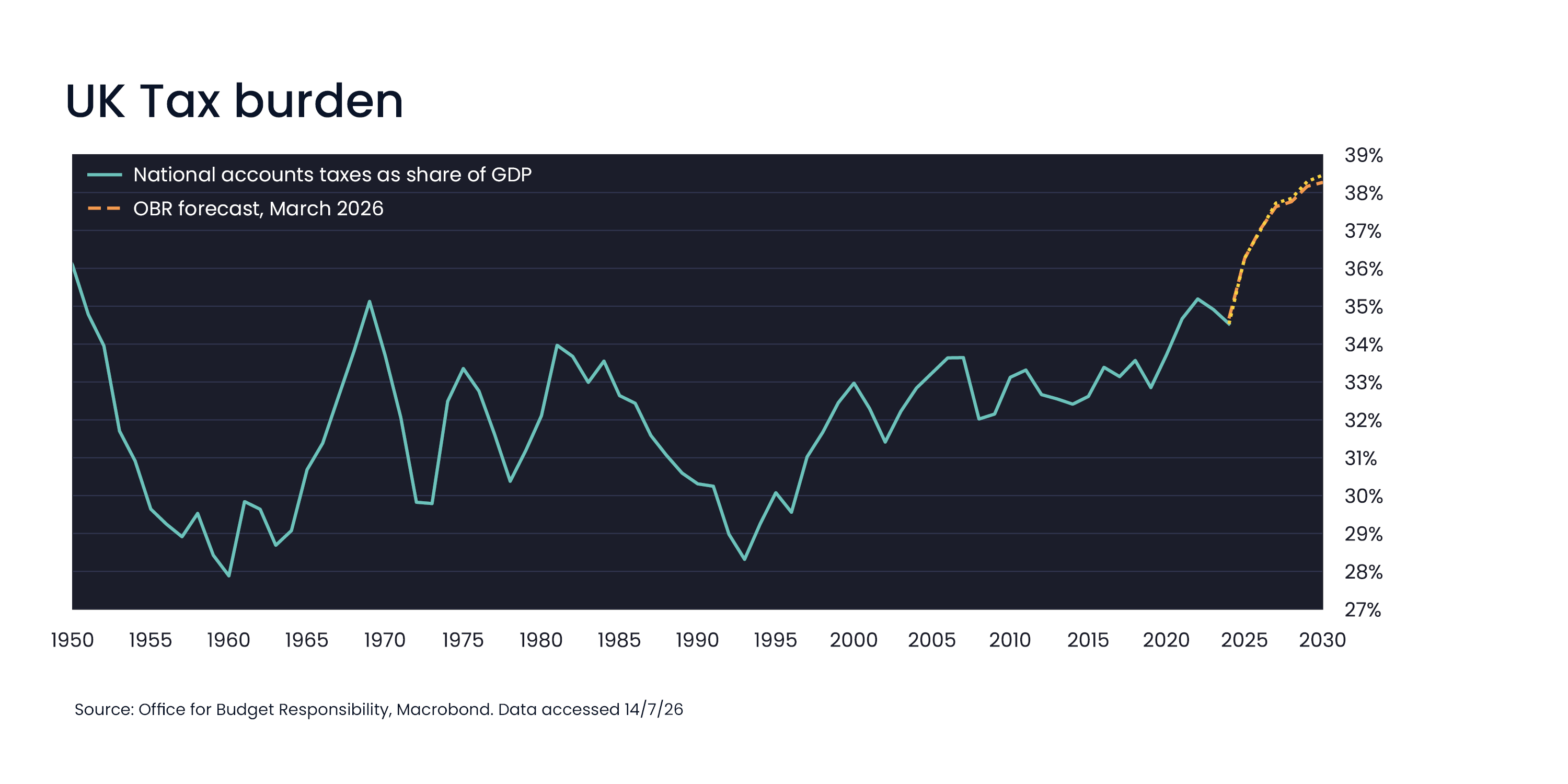
Currently 34.5% of GDP, the UK’s tax take is forecast to reach 38.5% by 2030. This overtakes the previous record of 37.2%. For much of this century until the pandemic, the national tax-take moved in a relatively narrow band. The
Covid pandemic and the accompanying emergency support programmes caused a rise in government spending. In order to finance this the government has used a combination of borrowing and tax increases. The sharp rise in energy prices in 2022 following the invasion of Ukraine also forced the government into providing further assistance for households and businesses.
Successive chancellors have used the simple mechanism of freezing the tax-threshold, instead of allowing them to rise to take account of inflation. This means that as wages rise with inflation, more workers get dragged into paying more tax. Chancellors from both parties have been able to raise more in income tax, despite not raising the tax rate. Known as fiscal drag, this has been a significant driver of government revenue over the past few years.
Elsewhere, corporation tax rose from 19% to 25% in 2023. More recently, the November 2025 mini-Budget increased taxes in a range of areas, including dividends and property.
SJP’s Hetal concludes: “With the tax burden set to rise, the options for the new prime minster and chancellor are unpalatable. Boosting growth through increasing investment incentives is a long-term strategy that will require patience from policymakers as well as the bond market.”

Most popular articles



Most recent articles