


- News
Welcome to the latest issue of Justin Onuekwusi, our CIO, quarterly insights.

Dry January always feels like a cruel joke to me, especially because my birthday falls on 2 January. Everyone’s on a health kick, gyms are packed, and I’m the guy asking if anyone wants cake. While everyone else is detoxing from December’s indulgence, I’m trying to celebrate in a month that’s all about restraint. It’s the worst timing for a party, but over the years, I’ve learned to embrace it. Markets teach the same lesson: timing isn’t always convenient, but corrections are inevitable. They’re not punishment, they’re progress.
*This newsletter was written prior to events in Venezuela but these have not changed our outlook.
Volatility – a smoother ride than usual
So, what can we take from 2025? If we look at volatility, an inevitable feature of markets and investing, earlier in the year investors saw sharp spikes (we referenced them as fat tails at the start of 2025) driven by factors from global trade tensions (tariffs in particular) to US fiscal debates, to ongoing geopolitical risks such as the conflict in Ukraine and in the Middle East.
Yet recently markets have been calmer, with volatility levels remarkably low, including the initial reaction to developments in Venezuela. Does this mean calmer times are ahead for investors? Can we feel confident that the time of extreme volatility is passing?
There are certainly reasons for cautious optimism and signs that many economies have weathered the headwinds of 2025 well. In the US, the Federal Reserve cut interest rates for the third month in a row in December. Lower interest rates, alongside a weaker dollar (as I discussed in the October CIO newsletter) are providing additional support for growth and the US economy is generally looking more resilient. While US unemployment reached 4.6% in November (according to US Bureau of Labor figures), it does not seem to be accelerating further. This is consistent; across most major developed economies labour markets have cooled without triggering a sharp rise in unemployment – this is an encouraging sign of underlying resilience.
Meanwhile, here in the UK fiscal policy remains tight, but the UK economy is still expected to grow at a steady pace next year, helped by looser monetary policy.
Could there be artificial intelligence (AI) bubbles ahead?
One of the most common questions asked by investors and clients I speak to is whether we are on the verge of a market bubble – in particular, an AI-fuelled bubble.
It is true that market performance in 2025 was once again dominated by the Magnificent 7 technology companies, with AI driving much of the growth. There has also been vast investment into AI infrastructure which has led to concern among some investors about how sustainable this is. While AI will likely continue to dominate much of the news flow, investors will need to see how widely its benefits can extend across other market sectors if they are to remain confident.
However, to take a more optimistic view, while valuations of many US tech companies may be at record highs - i.e. look expensive - a closer look at earnings doesn’t back up fears around a potential bubble. The S&P 500 has seen strong earnings growth over the course of the year and the fundamentals still look attractive, not least because of the resilience of the US economy. That said, we know valuations are the key driver of medium to long-term returns, therefore while US equities remain a cornerstone of global markets, and we continue to see strong opportunities there, we believe a much smaller allocation than the market weight is sensible in our portfolios.
Correction on the cards?
In December, major global markets from the US to Europe to Japan all hit new highs. This has been fuelled by resilient earnings and the Federal Reserve’s interest rate cuts, and coincides with soaring copper prices. Valuations in some areas already imply overly optimistic outcomes and there are significant valuation disparities across different asset classes. While we believe we are not yet in bubble territory, with markets at record highs, we have to remain alert that market corrections are inevitable.
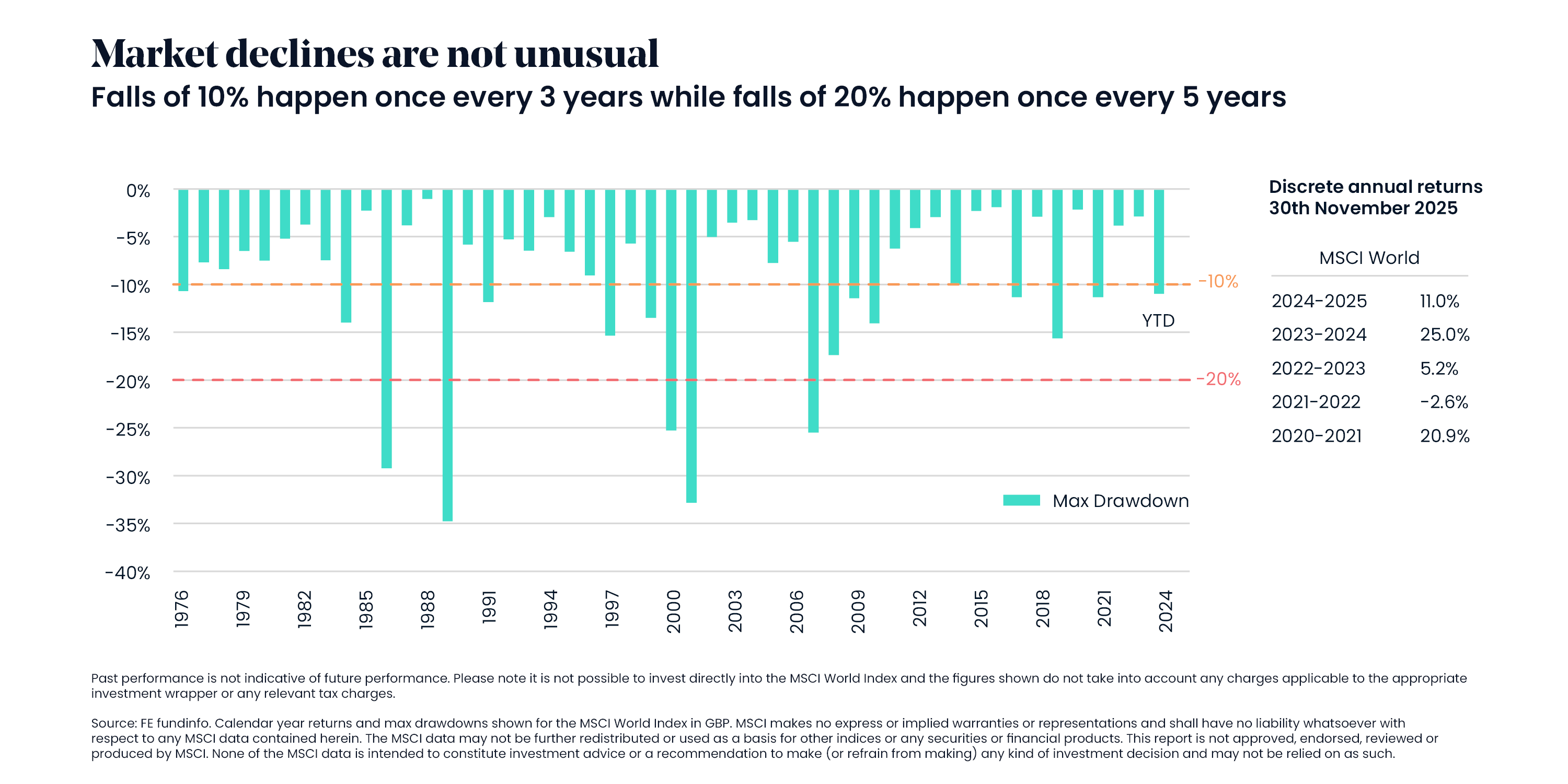
While market corrections might sound dramatic, they are more common than many people think. Typically, a market correction is defined as the market falling 10% or more from a market high – in other words a 10% peak to trough. A fall of 20% or more from a market peak is
known as a bear market.
As the chart below shows, market declines are not unusual. Falls of 10% happen once every three years on average. Meanwhile, falls of 20% happen once every five years. In other words, corrections are normal market behaviour.
In fact, the chance of markets falling by at least 5% a year is more common than not, based on MSCI World data. The chart below shows that between 1976 – 2025 the chance of an annual market decline – or drawdown – of at least 5% stood at nearly 70%.
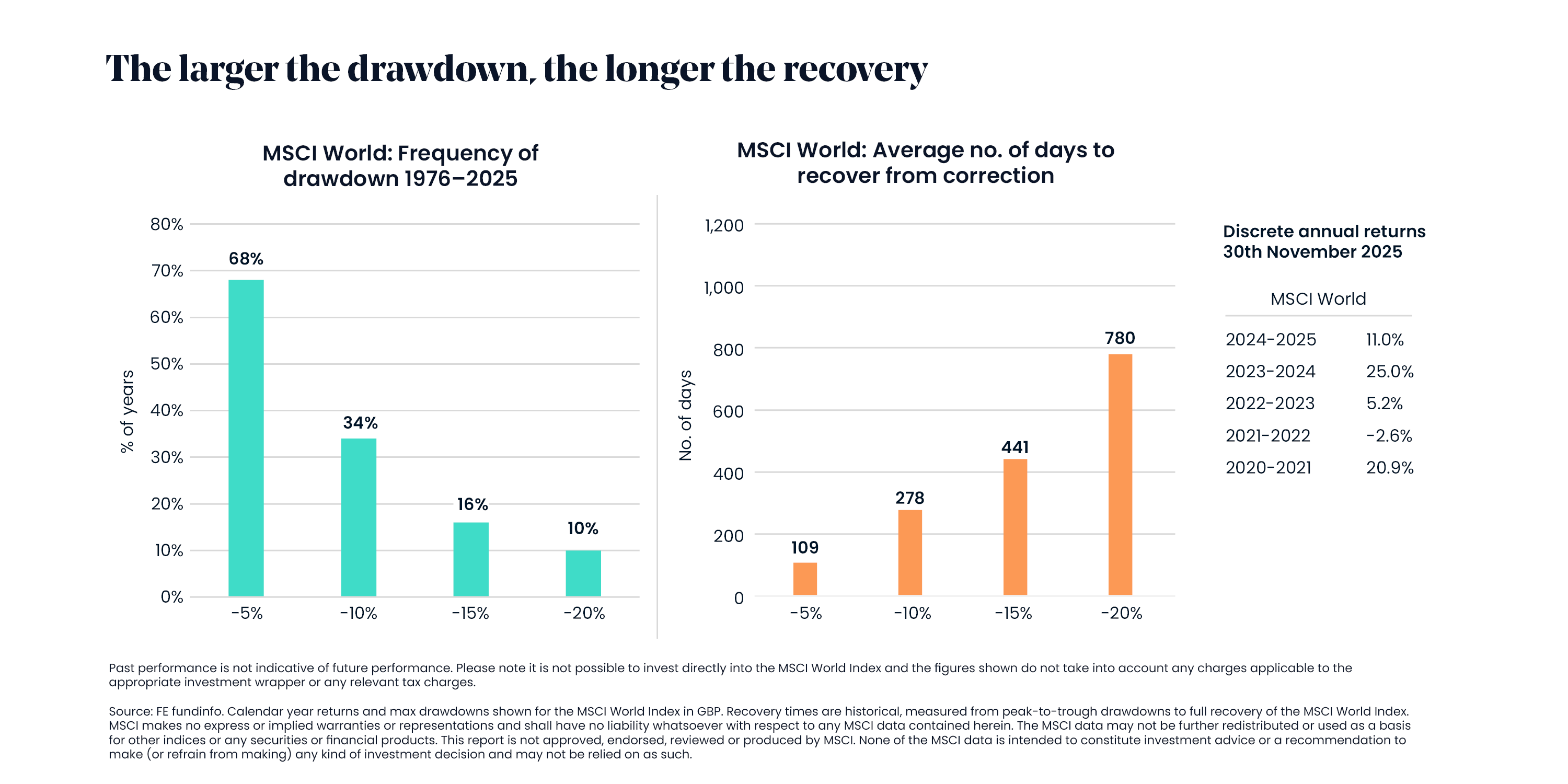
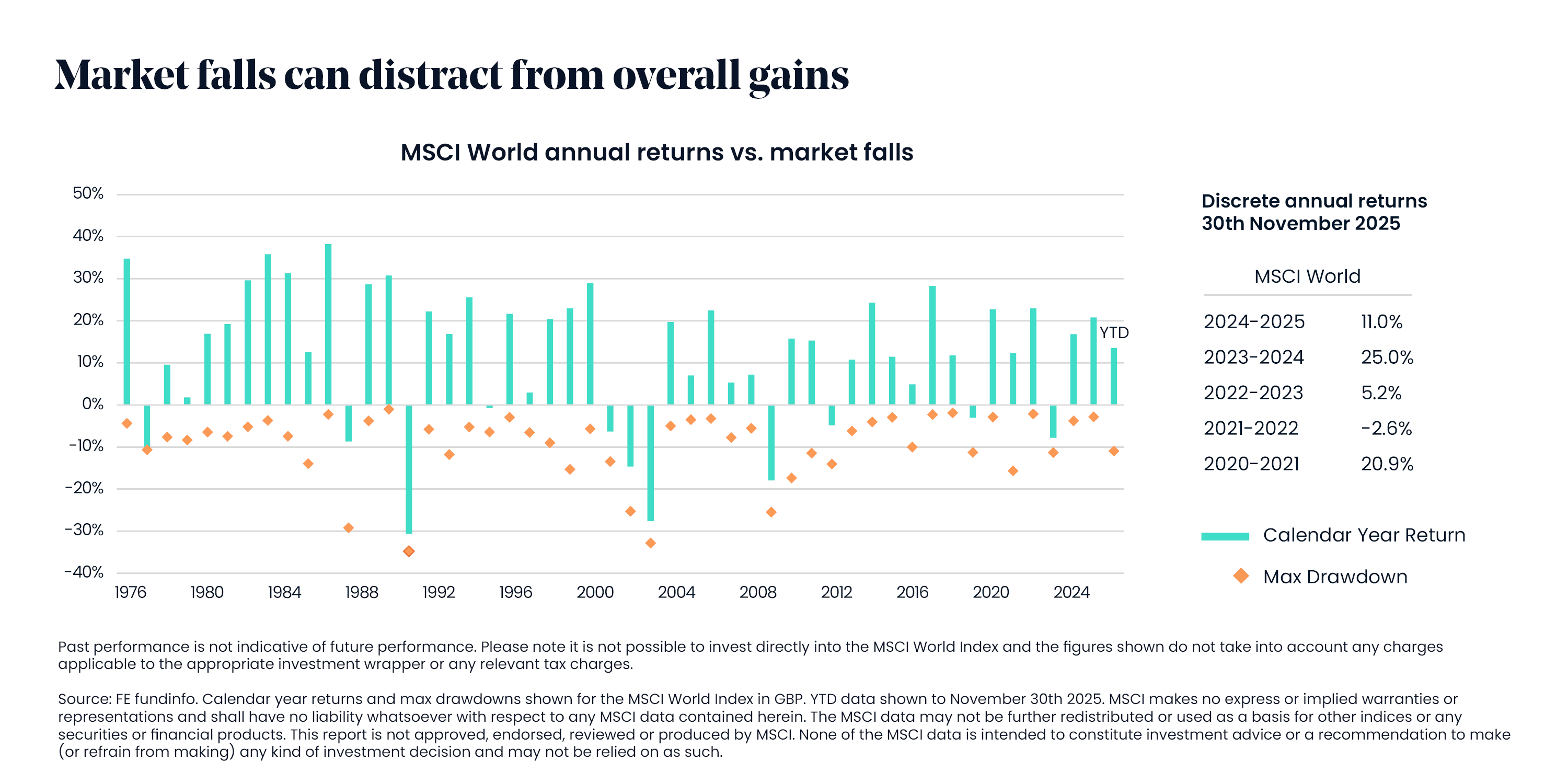
As the chart also shows, in most cases the larger the correction, the longer it can take for markets to recover. This underlines the importance of taking a longer-term approach rather than rushing to make decisions in response to market movements. Market falls often gain more attention among investors, which can also distract from the overall gains made over the course of the year and longer term , as the chart below shows. Even a 10% fall in the market is typically made back in less than a year.
Corrections also bring benefits for investors. The first is by taking some hot air out of the market, it can bring assets more in line with their underlying value. Removing the speculation allows people to see more clearly. It also gives space for investors to focus on the fundamentals of companies – earnings and real profitability – rather than being carried away on a wave of blind optimism. And of course, market corrections can also offer the opportunity for investors to invest in high quality assets at lower prices.
Navigating drawdowns
Market corrections are not only frequent, they are inevitable for long-term investors. Managing a portfolio through market peaks and troughs requires discipline and commitment and an understanding that periods of volatility are a part of investing for the long term.
The key is to be prepared for the ups and downs and follow the basic rules – stay invested, stay diversified and do not fear the volatility. Market ups and downs create new opportunities for disciplined investors. Our investment team remains vigilant in identifying these, and I encourage investors to stay attentive as well. It is often in uncertain periods where some of the most compelling opportunities emerge.
Conclusion
Market corrections are indeed inevitable. Just like my birthday, their timing might not be the most convenient but they are not a disaster, they are the detox that keeps markets healthy.

Most popular articles



Most recent articles