


- Retirement
Whether it’s a house, a car, a work of art, money or perhaps an inheritance, gifts are usually made with the best of intentions. But there are rules on gifting and receiving an inheritance that can, in some cases, create a tax liability for the people receiving them.
There are ways to eliminate or reduce the tax owed on a gift. But the rules are often misunderstood or overlooked.
If you’re receiving a gift or expecting an inheritance, it’s important to get to grips with their tax treatment, as well as any available allowances.

At a glance
- Beneficiaries should consider whether any gifts received or future inheritances have the potential to trigger tax liabilities.
- Insurance policies can help cover the financial impact of inheritance tax (IHT) arising from some gifts.
- Conversations with an adviser about gifting and protection can help as part of a wider estate planning strategy.
Understanding tax rules on gifting
For many families, gifting is likely to form an ongoing part of their estate planning, particularly as IHT rules are set for a significant change.
From April 2027, most unused pensions will form part of an estate for the purposes of IHT calculations, potentially bringing more families into the tax net.
For beneficiaries, it’s worth checking whether your family has a strategy in place to settle a potential IHT bill. This is particularly important when passing on illiquid assets, such as a property.
IHT is charged at 40% on the value of an estate above the nil-rate band (NRB) of £325,000. For homeowners, the threshold can rise to £500,000 if the residence nil-rate band (RNRB) is available – this is an extra £175,000 IHT-free allowance when the main home passes to direct descendants.
Any unused NRB and RNRB can pass to a surviving spouse or civil partner. Where the full RNRB is available, this means a couple could pass on up to £1 million free of IHT. Pension benefits left to a spouse or civil partner are free of IHT on first death. However, this may simply defer the liability rather than remove it.
To reduce the amount of IHT payable, many families use gifting as part of their estate planning to reduce the size of the estate during their lifetime.
But while some gifts come with no strings attached, others may generate a tax liability for the recipient.
That’s because if the person who made the gift dies within a certain timeframe after making the gift, it will be included in their estate when they die, for the purposes of calculating IHT.
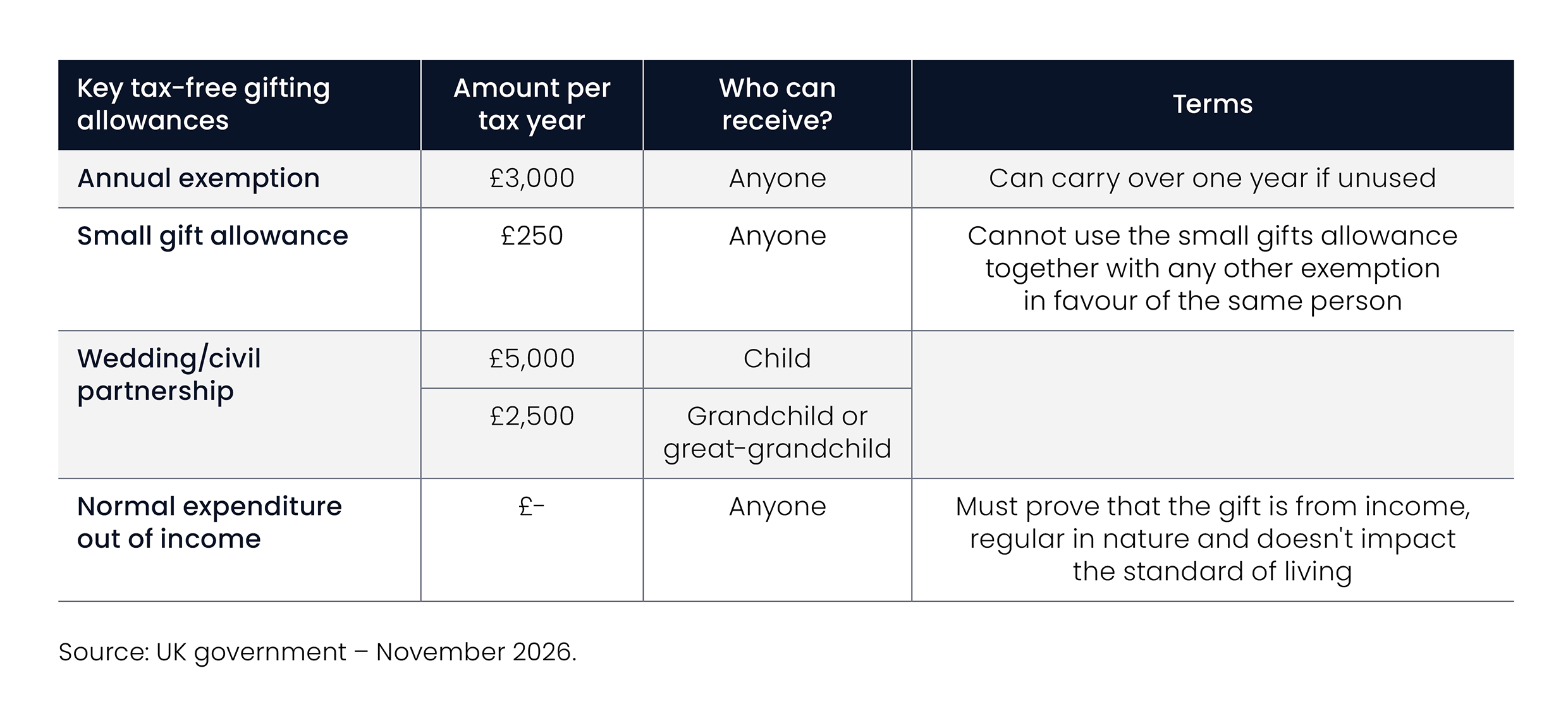
Below are some examples of qualifying gifts that may not trigger a tax liability. These allowances will depend on individual circumstances and may also change at any time.
Time as a factor
Larger gifts which fall outside the gifting allowances listed above are classed as potentially exempt transfers (PETs). This means that they’re free of tax as long as the person making the gift survives for seven years. If they die within seven years, the gift will usually be included in their estate for IHT calculations.
The nil rate band is applied against failed gifts. If a gift exceeds the NRB and the death occurs within three years, a 40% tax rate may be due if the estate is subject to IHT. From year three, taper relief will apply, with the liability reducing by eight percentage points each year, down to 8% at seven years. After this time, the gift will usually be considered to be outside the estate, which means no IHT will apply.
Niki Patel, tax and trusts advice lead at St. James’s Place, says: “Estate planning is about determining how your assets will be managed and distributed. Sometimes, people may forget that some of their actions, like gifting or leaving assets to certain family members, can generate a tax bill.”
Planning for an IHT liability
Whether you’ve received something valuable or expect an IHT bill will arise on the death of a family member, it’s worth having an open conversation with loved ones about plans for meeting the tax bill on time.
If IHT is owed on an estate, it must be paid at the end of the sixth month after the date of death, or interest will start to accrue. But this can be problematic if an estate is made up of illiquid assets, such as property or a family business, which could take time to sell.
Executors and beneficiaries could be forced to dispose of assets in at a market downturn, for example, simply to meet a tax bill.
Factors to consider include:
- What is the likely IHT liability on the estate?
- What PETs have been made and what are the tax implications?
- What are the strategies already in place to cover an IHT liability and what other options are available?
If these conversations feel challenging, it may be worth seeking support from a financial adviser.
When insurance can help
For liabilities that may be hard to cover, it is worth looking into whether insurance can help cover some of these costs.
For example, in cases where a gift could create a large tax liability (such as a large sum for a house deposit or school fees), decreasing term insurance could provide valuable peace of mind.
As the name suggests, these policies have a fixed term, with the payout decreasing over time, usually to match the associated tax liability, which will also reduce over time.
When it comes to gifting, this type of policy could match the seven years where tax may be due on a gift and decrease in value at the same rate as the taper relief.
Another option that may be suitable to help cover an IHT liability as well as gifting is whole of life assurance. This provides a lump sum to the beneficiary when the policyholder dies, whenever that occurs.
With these policies, the benefit can match or exceed the amount of IHT due. Additionally, most of these policies are written in trust. This means the payout doesn’t usually form part of the policyholder’s estate and therefore is not normally subject to IHT.
With any insurance policy, it’s worth remembering that failure to pay premiums may result in the policy ceasing and benefits no longer being payable.
A joined-up approach
Successful estate planning for families includes thinking about ways to reduce an IHT liability in line with wider financial and retirement plans.
But it also involves putting plans in place to help beneficiaries meet a potential IHT bill on time.
Niki notes: “Robust estate planning isn’t just about what is passed on, but how straightforward it is for loved ones to receive and keep it. Combining gifting and protection cover can help create greater certainty, helping families deal with potential tax liabilities while protecting the assets that matter most.”

Most popular articles



Most recent articles