


- Investing
- News
For years, pensions have offered a valuable tax advantage alongside retirement income, enabling people to pass on wealth to the next generation. But from April 2027, changes to inheritance tax rules could mean some families face a significantly larger tax bill than they expected.
In some cases, beneficiaries may face both inheritance tax and income tax on inherited pensions – this is known as the ‘double tax trap.’

At a glance
- From April 2027, most unused pensions and death benefits will fall into estates for IHT purposes. In some cases, inherited pensions may be subject to both inheritance tax (IHT) and income tax.
- If you pass your estate to a spouse or civil partner, it’s IHT free.
- There are financial planning opportunities such as gifting, annuities and insurance cover which can help lower the tax burden for your beneficiaries.
Who will this impact?
Inheritance tax is charged on estates worth more than £325,000 (the nil band rate). For homeowners, the threshold can rise to £500,000 through the availability of the residence nil-rate band – an extra £175,000 IHT free allowance available when a person’s direct descendants inherit your home.
If your estate (which is likely to include your unused pension from April 2027) exceeds this threshold, your unused pensions may face the 'double tax' trap.
However, if your pension is passed to your spouse, no IHT needs to be paid on the unused funds.
How does the 'double tax' work?
Currently inherited pensions may be subject to income tax in certain situations. For example, if you die aged 75 or over, a large lump sum payment is made. The move to bring them into estates for inheritance purposes from April of next year effectively adds a second layer of tax – IHT.
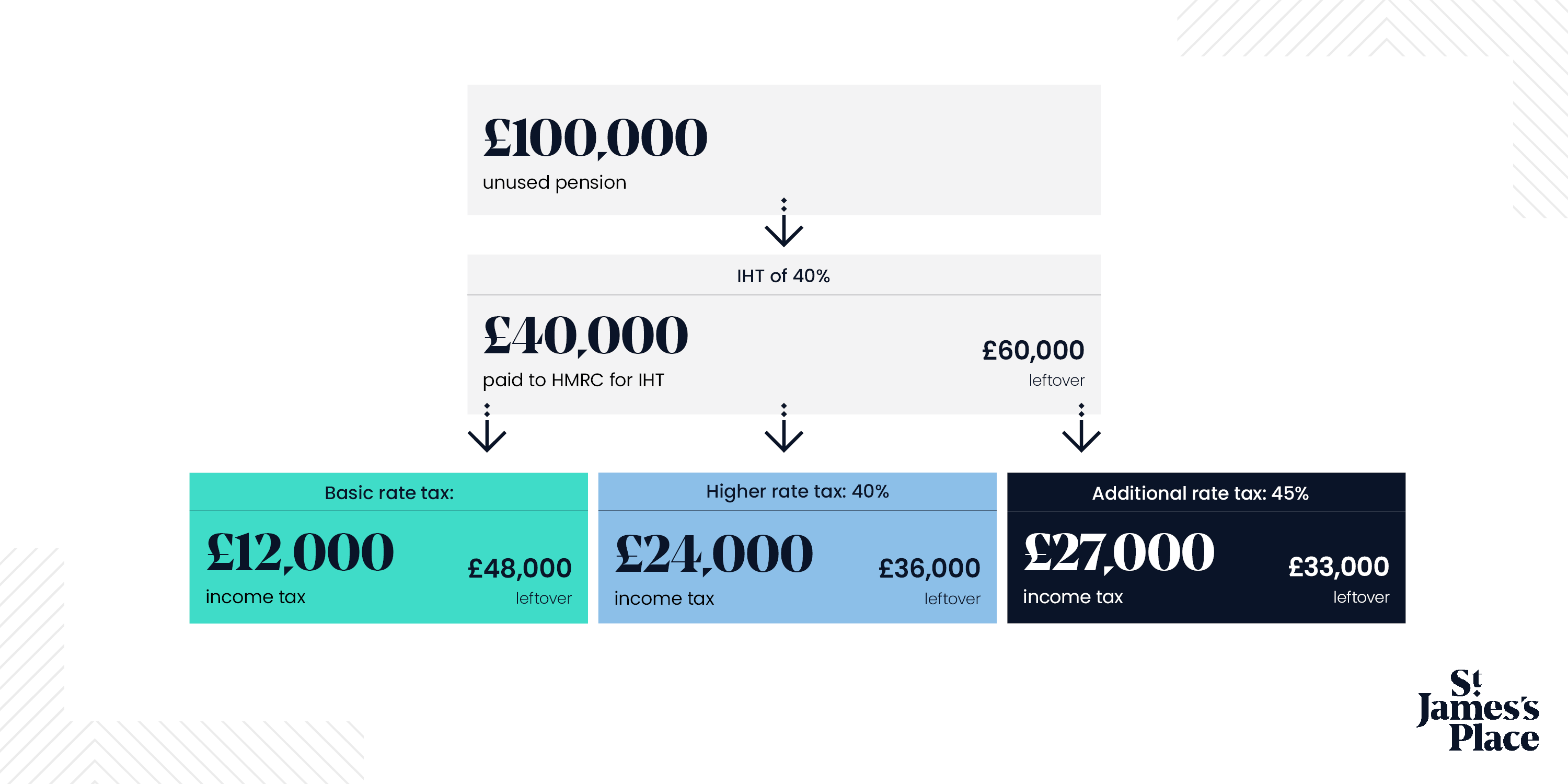
Let’s look at an example where you die aged 75 or over:
An unused pension of £100,000 (that has pushed the estate above the IHT allowance) would initially face IHT of 40% - £40,000. The remaining £60,000 may then be subject to income tax when the beneficiary withdraws it. The tax rate levied will depend on the income tax band in which the beneficiary’s income currently falls.
As the example demonstrates, beneficiaries can be left with significantly less than the original pension value once both taxes have been applied.
Niki Patel, Tax and Trusts Specialist at SJP says: “It is important to note that not all pensions are caught by the new rules, Anything left to your spouse or civil partner will be free from IHT on first death. Also, gifts to qualifying charities remain exempt, as do defined benefit pensions which usually pay an income for life.”
What are the financial planning opportunities?
The pension changes do not mean pensions have lost their value as a retirement planning tool. However, they may change how some people balance spending, gifting and estate planning. If you expect to leave a significant pension pot, it may be worth reviewing your plans sooner rather than later.
Here are some of the ways you can look to reduce the IHT burden:
Financially support your loved ones
Gifting and financially supporting your family throughout their lifetime can gradually move money out of your estate. The smaller your estate upon death, the smaller the IHT burden.
In the UK, cash can be gifted tax free at the time of giving. Up to £3,000 per year can be given with no future tax liability. There are also other IHT exemptions available. For example, making small gifts of £250 to a number of individuals or tax-free gifts of up to £5,000 per child and £2,500 per grandchild or great-grandchild when they get married.
However, if you make larger gifts and die within seven years of making the gift, it may fall into your estate for IHT purposes. This is known as ‘the seven-year rule.’ These rules apply to irregular cash contributions such as paying for university fees or gifting towards a house deposit.
Schedule gifts regularly
The ‘normal expenditure out of income’ exemption allows you to make regular gifts which are completely exempt from IHT – even if they are made within seven years of your death. This type of gifting is a more formal arrangement
and there are criteria that need to be met:
- Gifts need to be made from your regular income (this can be pension income)
- You need to be able to maintain your usual standard of living – the gift can’t make you substantially worse off
- The gifts need to be regular rather than a one-off payment
You should keep a log of what you have gifted – both one off and regular payments- as evidence for HMRC to agree that you have met the relevant requirements for the exemption to apply. You should ideally record when gifts are made, how much, for what purpose and to whom.
In need of more support?If anything here feels hard to process or you'd like to discuss how it might affect you, your financial adviser can help you take it step by step. |
Consider charitable giving
Leaving at least 10% of your net estate to charity can reduce the IHT rate from 40% to 36%. While this won’t eliminate the double tax trap, the 4% discount goes some way to reduce the tax burden. You should document these wishes in your Will.
Explore annuity options
An annuity allows you to exchange a portion – or all – of your pension savings for a guaranteed pension income usually until you die. There are several types of annuity arrangements to suit different life circumstances. For example, joint life annuities will cover both you and your spouse.
Using your pension to fund an annuity can move pension savings out of your estate – reducing what is liable for IHT, while also generating a secure, consistent income during your retirement.
Cover your IHT bill with whole of life assurance
Whole of life assurance is an insurance policy which provides a guaranteed cash payout to your beneficiaries when you die. If the policy is held within a trust, the payout to your beneficiaries will be made outside of your estate and therefore generally no IHT will apply.
This approach doesn’t remove the IHT liability. Instead, it plans for it by creating a source of funds to use towards paying the liability. This may prevent beneficiaries having to cover the cost of IHT themselves.
The tax rates and thresholds outlined in this article are subject to change and whether you may be eligible for them depends on your personal circumstances. The value of any tax benefits or reliefs will therefore vary from person to person and cannot be guaranteed.
Will writing involves the referral to a service that is separate and distinct to those offered by St. James's Place and along with Trusts are not regulated by the Financial Conduct Authority.

Most popular articles



Most recent articles