


- Investing
Women are living longer than ever before. But this throws into sharp focus the need to have a robust plan.
It is important to consider how much money you’ll need to support you through a comfortable retirement, ideally including provision for unexpected life events, such as a serious illness or the death of a partner.
It should also include considerations for potential long-term care costs to ensure you have as much independence and choice as possible.
Financial advice can help by focusing on your goals and priorities, bringing you clarity and confidence as you plan for later life. This can remove potential anxiety about your financial future and boost resilience.

At a glance
- The latest government data shows the average life expectancy for women is 83 years, compared to 79.1 for men1.
- Improved longevity means women are at greater risk than men of outliving their savings.
- Later life financial planning is about choices. Preparing now can reduce anxiety and financial shocks.
Planning for longer lives
Increased longevity is something to be celebrated. But it does pose specific issues for many women when it comes to financial planning.
Life expectancy for women is at an historic high of 83, according to government statistics, which look at average mortality rates across three year periods for more accurate comparison purposes. It compares to an average life expectancy of 79.1 for men.2
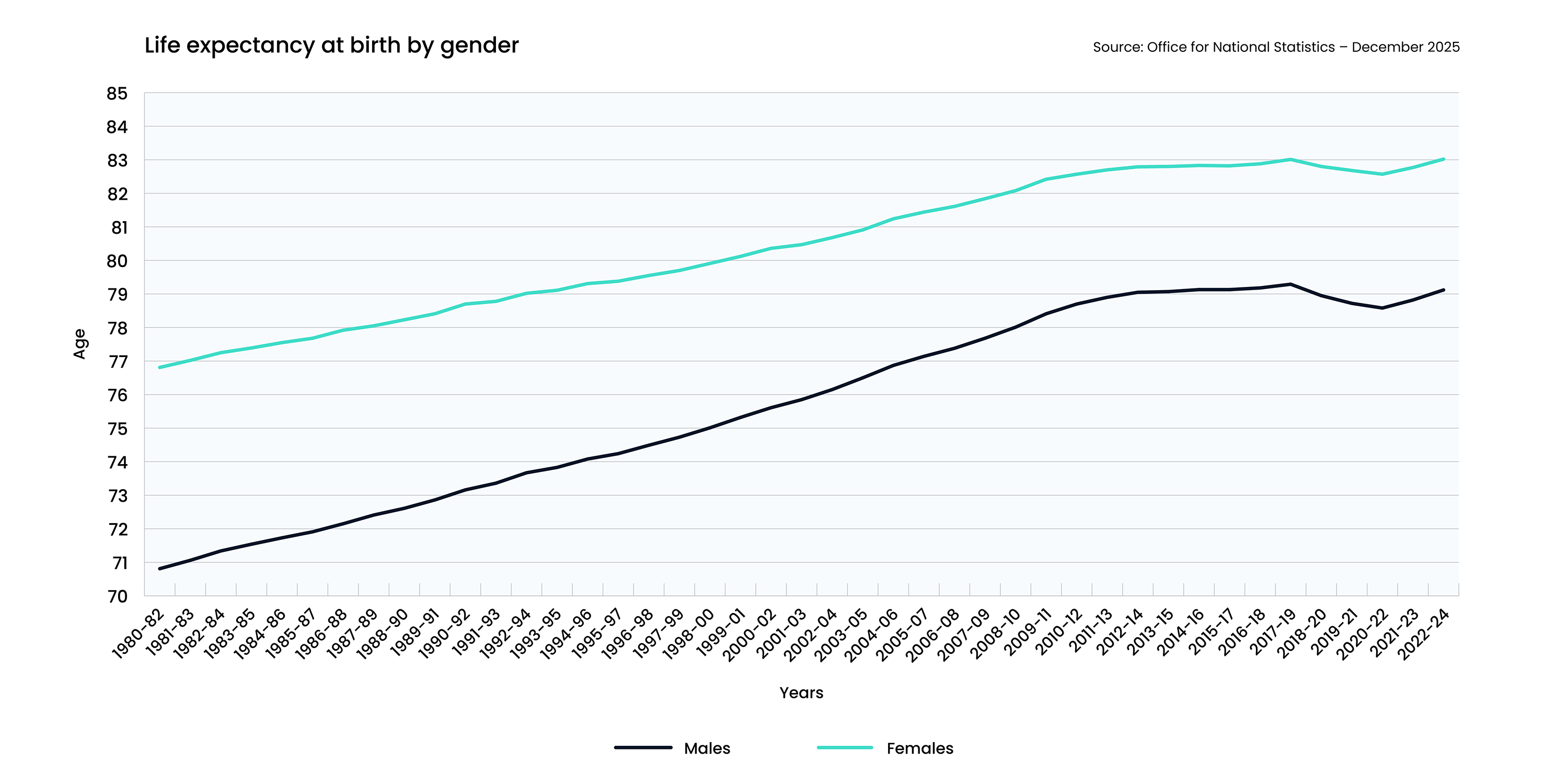
While these statistics are for life expectancy at birth, for a woman reaching the age of 65 today, life expectancy, on average, now stands at 21.2 years. That means potentially more than two decades in retirement, depending on when someone stops working. And of course, for many women retirement will last upwards of 25 or even 30 years.
While there are plenty of positives to a long life, not least the opportunity to spend more time with family, some women do feel anxious that their income and savings won’t be enough to live on as they age and as the cost of living rises.
Added to this, with a longer life comes the greater risk of ill health and incapacity. Women are more likely to need long-term care, for example, with statistics showing 60% of those in residential care and 59% of those in nursing care are female3. Again, there are significant financial implications to this.
Women also have less generous pensions than men, on average. Research by the Pensions Policy Institute shows women aged 55 to 59 have around half the pensions wealth of men of the same age4.
This tends to be down to women being more likely to have breaks in their working life due to caring responsibilities. Women are, on average, also more likely to work part-time and be on lower pay, compared to men.
Where married women are relying on a husband’s pension in later life, there is the risk they will only usually receive around half of this income in a widow’s pension, if their spouse dies first.
These realities present challenges for women as they start to make a financial plan for later life. But having an awareness of the issues is the first step in tackling them.
Talk with your adviser
Planning for later life is about working out how your income and assets will support you in retirement, including the potential scenario that you will need long-term care.
Your adviser will look at your personal circumstances and finances as they stand, your attitude to risk, and your priorities and goals, before working out a suitable plan to future-proof your finances for later life.
Some of the areas to discuss with an adviser are likely to include:
- How much will I need to live well in later life, and am I on track to achieve it?
- Do I have the money to ensure I can live independently for as long as possible, even if I’m in poor health?
- What are my options for funding long-term care?
- What insurance policies could I put in place to act as a safety net?
- If I inherit money how best can I use that to support me in later life?
Preparing for life events
As well as thinking about long-term care there are other unexpected major life events that can precipitate big financial decisions and changes. These include illness, incapacity, and the death of a partner.
Preparing financially for such events may not make them any easier to deal with emotionally. But having a plan, and a financial safety net, can reduce the stress around these difficult times.
Our own research found that only one in five couples (20%) have discussed in detail what would happen in the event of illness, separation or death. Yet having these discussions early, however awkward or difficult it may feel, can make things much easier later on and increase women’s independence.
Steps to take now
Review your pension arrangements and other long-term savings to get a projection of your expected income in retirement. This can help you identify any shortfall and work out how much you need to be saving to achieve your retirement goals.
Consider insurance cover, particularly critical illness and income protection cover, where relevant. While policies are risk-priced and can become expensive the older you are, or if you have pre-existing health conditions, protection cover can prove a lifeline when unexpected life events occur.
Discuss your hopes and plans for your retirement and later life with your partner, your children, or wider family.
Early and open conversations around your expectations and wishes, your plans for funding long-term care, for example, and any implications for passing on a legacy, can really help your family when the time arrives.
Putting in place a Will and lasting powers of attorney are also important.
Financial advice can support you and your family by looking at your specific situation. This can help you consider all the options.
Building a long-term plan can boost confidence and financial resilience, forming the foundation for independence in later life.
Sources
1, 2Office for National Statistics. National life tables – life expectancy in the UK 2022 to 2024. 10 December 2025.
3Local Government Association. What is the gender split of people in long-term support? July 2024.
4Pensions Policy Institute. The Underpensioned: Updating the Gender Pension Gap. 15 September 2026.

Most popular articles



Most recent articles